Thumbing the Files
61 Years Ago – October 28, 1965
If there is one Milford debate that never seems to go entirely out of style, it is downtown parking. It was an issue in 1951, it remains one in 2026, and on October 28, 1965, the town was once again trying to figure out where everybody was supposed to park their cars.
The Cabinet summed up that particular round of the discussion with a wonderfully concise phrase: “Let George do it!” For those of us who aren't up to date on our ‘60s slang, there was no George. This simply meant, more or less, let somebody else take care of it. And that turned out to be a pretty good description of the meeting.
Local businessmen had met with the Planning Board at the library, and everyone agreed that downtown needed more parking. The businessmen thought the selectmen ought to take the lead. The Planning Board thought the businessmen should. Milford had apparently found the parking problem. Finding George was proving more difficult.
Fortunately, readers looking for a more ambitious solution only had to turn a few pages. There the Cabinet offered another possibility: a 79-foot Ferris wheel for cars.
“Parking Lots of the Future — Towers Like Ferris Wheels,” announced the headline. The Swiss-designed Wulpa Parking Tower apparently could suspend 20 automobiles in cradles rotating around a steel tower, using just 564 square feet of land. Push a button, an empty cradle descended, you drove aboard, and up your automobile went.
Elsewhere, a very different part of the 1960s made an appearance at Town Hall. The Hillsborough County Forest Fire Wardens Association gathered for its annual meeting, where 114 members and guests enjoyed supper prepared by the ladies of the Baptist church. Milford pharmacist Ray Dyer was in charge of the supper, officers were elected, and then the evening took an unexpected turn.
The guest speaker was a State Police lieutenant, and his subject was rather foreign to the good folks of Milford: riots. The previous summer, a large crowd of young people had rioted at Hampton Beach in a disturbance serious enough to bring in the National Guard. Officers were now studying new riot-control techniques at Pease Air Force Base; the old methods, the speaker explained, were no longer as effective as they once had been. To finish the evening, the fire wardens watched a film of the Hampton Beach riot.
It must have made for a strange night at Town Hall: supper, election of officers, and then film footage of thousands of young people battling police. It was 1965. The decade was beginning to change.
The future was arriving in other ways, too. A computer in a White River Junction warehouse was helping keep Milford’s Super Save stocked. The store stood on the hill above the Oval, where Governor John McLane’s home had once stood and where Rite Aid would later be located. The Cabinet, apparently aware that “computer” still sounded like something from a science-fiction movie, explained that most people associated such machines with “outer space, missiles and rockets, or banking.” This one was an IBM data-processing system used to track some 5,000 products, fill orders and manage inventory. Its equipment looked, readers were reassured, no more complicated than an oversized typewriter, while its discs were described as the computer’s mechanical “brains.” An order placed by 9 p.m. could arrive at the Milford store the next morning. It was a brave new world for Super Save stocking.
Super Save itself was getting into the spirit of the season. “Nothing Spooky About Our Values!” promised a full-page Halloween advertisement, offering, among other bargains, three pounds of sweet potatoes for 25 cents.
Indeed, throughout the paper, there was plenty of evidence that the spooky season had arrived. An estimated 716 schoolchildren in grades one through six were to march in costume from the Garden Street School to the Square, around the Oval, and back again.
Around town, 500 children and adults packed the Wadleigh Memorial Library program called “Science Magic,” where a scientist from the Boston Museum of Science turned a potato, drinking straw, hammer and nail into objects of fascination. And the Odd Fellows were preparing for another season of indoor baseball, with Milford scheduled to take on teams from Nashua, Reeds Ferry, Hollis and Wilton.
Parking problems and indoor baseball. Riots and Halloween parades. Milford in 1965 could feel remarkably familiar one moment, and like a glimpse of the future the next.
Though, as it turned out, that future never quite included a 79-foot Swiss parking Ferris wheel. ✧

Thumbing the Files
75 Years Ago – Sept. 13, 1951
Summer hadn't quite loosened its grip on Milford when the September 13, 1951, edition of the Milford Cabinet landed on doorsteps three-quarters of a century ago this week. Here are a few of the things that caught our eye while flipping through the paper.
Back-to-school season was in full swing, and student reporters Ruth and Barbara kept readers up to date on the latest happenings at Milford High School. Their column reported that the hallways had been repainted pale green, and the old library had been converted into a typing room with a large window, allowing the teacher to "keep an eye on the typists." Apparently, the students of 1951 didn't need a Wi-Fi connection to find ways to wander off task.
While students were settling back into the classroom, Milford was already looking ahead to one of the community's biggest events of the season: the Grange's annual Old Time Country Fair. The Cabinet repeatedly assured readers it would be a "real" Old Time Country Fair—as if imposter country fairs had recently been invading the New England countryside.
The fair featured decorated doll houses, free ice cream, a "Miniature's Band," and a real Italian dinner prepared by the "fancy cooking work" of Mr. and Mrs. Dominic Rocca. The day concluded with a community variety show. All the makings of a good ol' country time.
Apparently September 1951 was Milford's season for all things old-fashioned. In addition to the "Old Time" Country Fair, the Purgatory Falls Fish & Game Club advertised an "Old Fashioned Dance" hosted by the venerable Win Whipple and featuring music by "The Old Timers of Milford." Indeed, plenty of "old-timey" times around Milford that week.
Down on the Oval, the Latchis Theatre wasn't giving top billing to a movie at all—it was giving it to the words "AIR CONDITIONED." At the tail end of a New Hampshire summer, that may have been the real star attraction. Moviegoers could also catch the long-forgotten Fort Worth and No Questions Asked, or Alfred Hitchcock's Strangers on a Train. While both Hitchcock and his thriller would become legendary in the decades that followed, the film was simply one of several movies playing at the Latchis that week. Still, moviegoers' top priority may have been less about Oscar-worthy cinema and more about simply getting out of the summer heat.
Flip past the headlines, and the advertisements paint an equally vivid picture of life in Milford during the early 1950s.
County Stores Hardware, which was still located on the Oval in 1951, was touting firearms over hammers and nails. The advertisement promoted "fall values for sportsmen and hunters," including a Remington Model 514 .22-caliber bolt-action single shot, a Winchester Model 37 12-gauge, and, lest customers leave empty-handed, "plenty of ammunition." And of course, no background checks or paperwork. Just pick up your gun and head home.
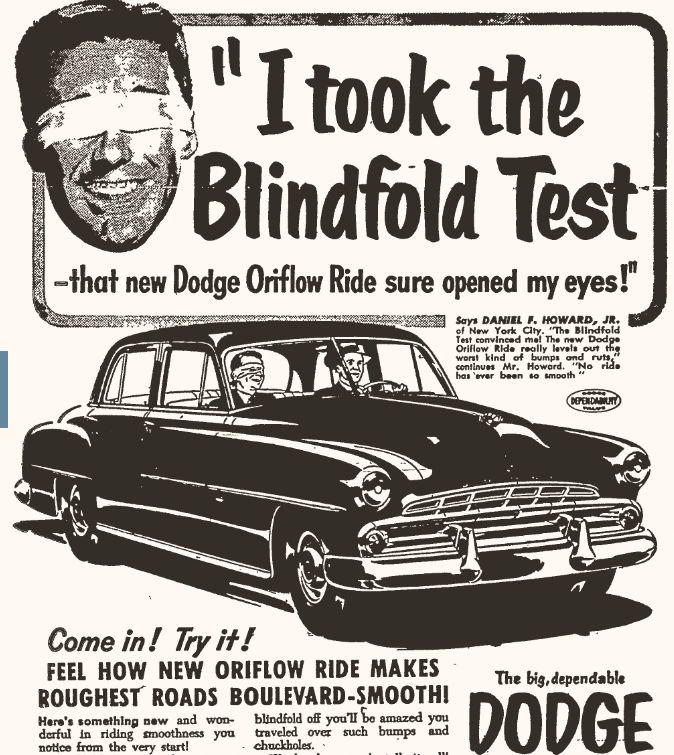
Meanwhile, Milford Home Furnishings encouraged customers to take advantage of a free home trial of a television set. Apparently, television was still new enough in 1951 that consumers first wanted to kick the tires, as it were. The Elm Street Garage invited readers to try Dodge's famous "Blindfold Test." With a drawing of a blindfolded man and an automobile, you have to look twice to realize Dodge wasn't actually suggesting he drive that way. And Boston Shoe Stores promised that its Army-type work shoe was "a whiz for durability ... and a whiz of a price, too."
All in all, it was a whiz-bang week of old-time fairs, air-conditioned movies, television test drives, and enough hometown charm to make September 1951 feel both familiar and wonderfully strange.

Thumbing the Files
50 Years Ago – August 15, 1976
Looking back a half century to the week of August 19, 1976, the Milford Cabinet had just about everything: vandalism, beauty queens, grocery bargains, Hurricane Belle—and, for reasons known only to the Board of Selectmen, an unusual amount of discussion about bathrooms.
Vandalism in town was clearly the story of the month. It dominated both the front page and the opinion page, where one column began with the memorable line: "There is something sad about vandalism. Sad, and at the same time infuriating." The examples seemed endless. The Oval drinking fountain was smashed for the third time that year, dressing rooms at the Keyes Field swimming pool were repeatedly damaged, gravestones were tipped over, and the American flag was stolen from the Oval. The editorial summed up the town's frustration with what it called the "frustrating, infuriating question: Why?"
Town officials had apparently reached their own conclusion about who was responsible. After repeated vandalism at Keyes Field and on the Oval, selectmen announced, "Until they decide they can act like ladies and gentlemen, the benches are to be removed." One park-goer could only shrug after the benches disappeared: "I guess I'll sit on the ground."
Fortunately, not all the news was discouraging. The Hutchinson Homestead on North River Road received national recognition as a "Landmark of American Music," honoring the Hutchinson Family Singers, Milford's famous musical family, during the nation's
Bicentennial celebration. It was one of only four such sites recognized in New Hampshire.
Preparations were already underway for the Hillsboro County Fair, where young women ages 16 to 22 were invited to compete for Fair Queen. The winner—and "her court"—would be announced on opening day so they could "reign for the duration of the fair." County fairs still have tractor pulls and fried dough. Teenage Fair Queens? Not so much.
Meanwhile, Hurricane Belle had the Cabinet staff briefly wondering whether the newspaper would be printed at all. With the paper's editor paddling down the Allagash River, staff members found themselves spending "several fascinating hours planning how a newspaper might be printed from hand-scrawled rather than type-set galleys." Fortunately, Belle gave Milford the slip, the lights stayed on, and everyone, as the editorial put it, "waded to work."
The Board of Selectmen spent at least one meeting discussing matters at opposite ends of the plumbing system. Selectmen wrestled with where Hampshire Hills Health Club should put its sewage while finally settling another issue much closer to home: where to install two long-awaited public restrooms. The verdict: the custodian's closet.
The advertisements in that week's paper offered their own glimpse into everyday life in 1976. Down at Violette's Market, porterhouse steaks were going for $1.99 a pound, New York sirloin for $1.79, and "Plum o' Rama" selections were just 39 cents a pound. Over on the car lot, one leasing company knew just what "Mr. Businessman" needed. That turned out to be a brand-new Chevy Monte Carlo for $159.59 per month. Meanwhile, newcomers to town were welcomed the old-fashioned way. A Cabinet advertisement featured a smiling Welcome Wagon hostess with a simple greeting: "Hello, stranger."
So there you have it: the week of August 15, 1976—vandalism, a near-miss hurricane, county fair beauty queens, bargain steaks, and altogether too much discussion about using the facilities. □