The Rambling Reporter - October 25, 2026
Somewhere along the way, Halloween became a very big deal.
It arrives earlier now, and stays longer. For children, Halloween was always a big day, but it was not yet a season. It certainly wasn't waiting for us in the stores while we were still buying sunscreen.
Halloween, it seems, got promoted.
These days, the first temporary Halloween stores can appear before anyone has put away the beach chairs. By October, whole neighborhoods glow orange. Front yards have acquired graveyards, fog machines, enormous inflatable ghosts and twelve-foot skeletons peering over the shrubbery. A respectable Halloween display can now require nearly as many extension cords as Christmas.
The costumes have undergone a similar transformation. Those of us of a certain age may remember the old drugstore variety: a thin plastic costume accompanied by a rigid plastic mask, secured to your head with an elastic string that seemed engineered to snap sometime before the third house.
Today, a trip to a Halloween store is a considerably more ambitious undertaking. There are seemingly acres of costumes, masks, wigs, makeup and accessories, with enough choices to turn virtually anyone into virtually anything. It is also surprisingly easy to enter intending to outfit one child and emerge $60 or $70 poorer.
Halloween has become not merely a holiday but a kind of national theme.
Television shows have Halloween episodes. Restaurants have Halloween specials. Stores have Halloween displays. There are Halloween parties, Halloween dances, Halloween movie marathons and Halloween events that begin weeks before Halloween. "Spooky season" has entered the vocabulary.
──────── ♦ ────────
Then there is pumpkin.
Pumpkin has somehow escaped from the pie and taken over autumn. It can be found in coffee, cereal, cookies, candles and products that would seem to have no earthly need for pumpkin. I remember seeing a joke online advertising pumpkin-spice motor oil at an Exxon station. It was funny mainly because, by this point, it didn't seem entirely impossible.
In that respect, Halloween has begun to resemble Christmas. It provides a common cultural language that virtually everyone recognizes. Come October, an advertiser need only add a bat, a ghost and a splash of orange to announce that it, too, is participating in the season.
And yet the Rambling Reporter has noticed something curious about all this.
As Halloween has become bigger, it has also become tamer.
The decorations may be more gruesome. Horror movies certainly haven't lost their nerve. But the holiday itself feels considerably less menacing than the Halloween many of us remember.
As the story elsewhere in this edition recounts, Milford once spent a surprising amount of time worrying about Halloween. There were smashed windows, vandalized signs and warnings from the police. Later came the fears about razor blades and needles hidden in candy, and an era when plenty of children did their trick-or-treating while the sun was still safely overhead.
Modern Halloween, for all its skeletons and severed limbs, is a remarkably well-organized affair. There are school parades, downtown events, carefully supervised trick-or-treating and front yards filled with families. The little ghosts wandering Milford's streets are considerably more likely to encounter a motion-activated zombie from Home Depot than an actual Halloween hoodlum.
And for all the easy jokes about $70 costumes and pumpkin-flavored everything, this may not be such a bad development. Halloween remains one of the rare occasions when children dress up as something ridiculous, wander around their neighborhoods after dark, knock on the doors of people they may barely know and are rewarded with candy for doing so. There are worse traditions to turn into a national obsession.
The corporate machinery may have discovered Halloween, but it hasn't quite managed to spoil it.
Perhaps that is the oddest part of Halloween's transformation. We have made it bigger, longer, more elaborate and vastly more expensive. We have surrounded ourselves with towering skeletons, artificial graveyards and enough fake cobwebs to ensnare the entire population of Milford.
And somehow, while making Halloween look much scarier, we made Halloween itself a little less scary.

The Rambling Reporter - September 14, 2026
There are some moments in parenthood you know are important before they even happen. One of them is that first walk to the Jacques School. Every September, dozens of Milford youngsters, backpacks nearly as big as they are, begin a new adventure. It's a milestone not just for the children, but for their parents as well. In a way, it's a rite of passage that nearly every Milford family has experienced, or soon will.
Each morning, the journey begins at the crosswalk on Elm Street. With a smile and a wave, longtime crossing guard Miss Julie ushers groups of children safely across as traffic patiently waits. School buses line up, cars pause, and for a few minutes the center of town belongs entirely to the youngest members of the community. Once across the street, the children head down the familiar walkway toward Jacques, backpacks bouncing, until they disappear through the doors of the school. Parents linger for just a moment, watching them go before heading back to the rest of their day.
I remember making that walk a few years ago with my daughter. Looking back, it struck me that thousands of Milford families have stood in almost exactly the same place. Jacques Memorial School has been welcoming children for nearly seventy years. The faces have changed, but the emotions probably haven't.
The two photographs below capture children on that same walkway nearly seventy years apart. The 1955 image shows students leaving Jacques at the end of the school day, while today's photograph captures the beginning of a new one. Different children. Different clothes. Different backpacks. A similar journey.


When Three Schools Shared the Oval
Watching the morning drop-off at Jacques nowadays, it's hard to imagine how busy the Oval must have been back in the day.
Before Heron Pond School opened out in the woods of West Milford, all three elementary schools sat within a few hundred feet of one another. Jacques School served older as well as primary students. Next door, the old high school building served as the Bales School. And just across Elm Street, where the Milford Police Department now stands, the Garden Street School looked down over the Oval from the top of the hill.
For a little while each morning, the heart of Milford was a mob scene of kids. Parents pulled to the curb, buses arrived one after another, crossing guards stopped traffic, and streams of children headed off in every direction. It must have been a wonderfully chaotic way to start the day.
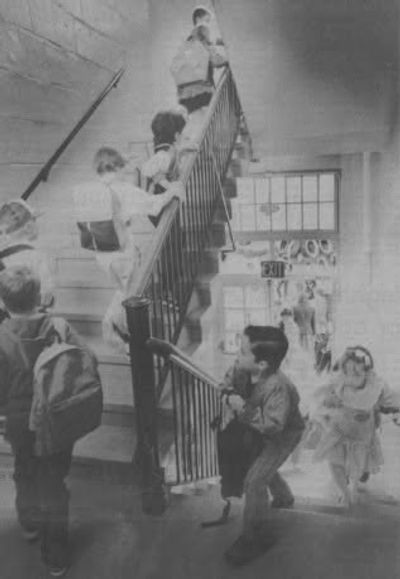
The photograph below captures students climbing the stairs to the Garden Street School in 1989. Those boys and girls, busy talking with friends and probably thinking about spelling tests or recess, are now in their 40s.
If you attended Garden Street or Bales, I'd love to hear your memories. Did you walk to school? Who was your favorite teacher? And do you remember what those busy mornings around the Oval were really like? Let us know at: editor@milfordhistorian.com
The Summer of the Squishy
Every generation seems to have one toy that completely takes over for a little while.
When I was growing up, it was things like Rubik's Cubes and Cabbage Patch Kids. Other generations remember Hula Hoops, Beanie Babies, Pokémon cards, or Furbies. They arrive almost overnight, every child suddenly has to have one, adults wonder what all the excitement is about, and then—almost as quickly—they disappear.
Last winter, it seemed like every child in Milford wanted a Labubu. Parents were hunting them down before Christmas, and stores could barely keep them in stock. Then, almost overnight, the craze faded away.
This summer has belonged to the squishy.
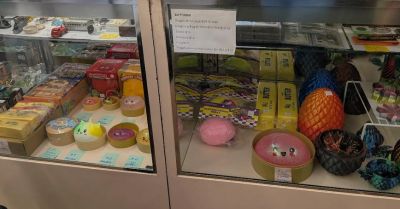
If you don't have young children, you might not know what a squishy is. Most resemble smiling little foods—a steamed dumpling with a happy face, a giant strawberry, a chocolate bar, even a stick of butter. They're made of a soft, squeezable material that's oddly satisfying to hold. (The dumplings are based on Asian-style steamed buns or dumplings, often sold in cute little takeout-style boxes.) Around Milford, they've become so popular that Toyland on Nashua Street and Serendipity on the Oval have created special displays near the checkout counter, complete with signs announcing when new shipments arrive and limits on how many customers can buy at one time.
Of course, every great toy craze eventually finds its way into classrooms, camps, and after-school programs. At first, teachers usually try to let children enjoy the newest fad while encouraging them to share responsibly and take care of their belongings. It's a good lesson in growing up. But sometimes the trading, the borrowing, the arguments, and the inevitable popped or missing squishy become just a little too much. Eventually someone throws up their hands and says, "That's it—no more squishies."
In a way, it's the same balancing act schools face with so many things today, from collectible toys to cell phones. Whenever possible, we'd like children to learn how to use these things responsibly. Sometimes, though, the distraction simply outweighs the lesson.
By the time you read this, the next big thing may already be on its way. That's the funny thing about childhood fads. They feel like they'll last forever, but a few years from now today's kids will probably smile when someone mentions squishies the same way today's adults smile when someone mentions Cabbage Patch Kids or Beanie Babies
The Rambling Reporter - August 17, 2026
Recreation directors probably carry around an idealized version in their heads of a summer evening at the local park. On a recent visit to Keyes Park, I stumbled onto a scene that likely comes pretty close to that vision.
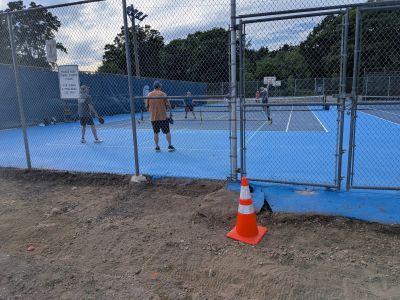
With a few minutes to spare before my nightly Boys & Girls Club pickup, I wandered across the footbridge over the Souhegan. It was nearly 5 o'clock in the evening, and the park was hopping. The pickleball courts were full, there was some sort of cookout going on by the picnic tables, kids were trying out the slides, and teenagers were showing off at the skate park.
The scene was in sharp contrast to the summer of 1976 featured in the Thumbing the Files roundup elsewhere in these pages. Keyes Park was busy then, too, but not always in ways town officials appreciated. In a single week, new lamplights were smashed, pool loudspeakers were ripped from their mountings, and somehow, tennis nets wound up floating in the Souhegan River.
Fifty years later, the pickleball craze seems to have brought new energy to the courts, while Keyes Park itself has found new footing. At least on this particular evening, the park looked a lot like what those who planned it probably had in mind.
All in all, a fitting scene for a fine summer evening.
Pickleball, it seems, has become the Ultimate Frisbee or badminton of the 2020s. As with those sports in the ‘70s and ‘80s, it seems like suddenly everyone and his brother is suddenly out on the pickleball courts.
The Rambling Reporter has tried his hand on the court for the past few years and, despite a name that can be slightly embarrassing to say aloud, has come to appreciate the game's unusual appeal.
Pickleball seems especially well designed to narrow the athletic gap. Sure, there are professional players and even leagues you can watch on YouTube, but in your average two-on-two match at the park, the sport has a certain leveling effect.
Last week, I was paired with an older gentleman and, after a few points, I soon realized he was basically as good as I was. He kept hitting forehand winners down the line and using a spin serve that was giving considerably younger opponents fits. Finally, I turned to him and asked, “Nick, how old are you anyway?”
“Eighty-three,” came the reply.
Such is the curious leveling effect of pickleball.
Milford residents have been keeping score in the Great Empty Storefront Game for years.
A new restaurant sign appears on a marquee and everyone makes plans to check the place out. Brown paper goes up somewhere else, and people begin predicting the downfall of the Oval.
I found myself doing my own informal count during a recent walk downtown. There are a few empty storefronts, and because they are on the Oval, they seem to attract more attention. A vacant unit in a strip mall is a vacant unit. An empty window on the Oval can become a discussion about the economic health and survival of downtown Milford.
There was a time when the Oval had the kind of lineup of businesses you might expect to find in Bedford Falls. There was the required movie theater, a bookstore, an ice cream shop, a record store, a pizza joint and a working gas station. Most of these businesses existed at the same time, something that is difficult to picture now.
The economic world has changed. Walmart and Target are just a drive down 101A and offer (under one roof) most of the things people once went downtown to buy. The modern Oval has adapted. Restaurants, bars, barber shops, antiques, collectibles and boutiques now make up much of downtown — basically things that cannot be found on Amazon or in the big box stores.
On weekend mornings, the breakfast crowd can make the Oval feel downright busy. Sunday's Ice Cream opened last year and Milford celebrated. Sugar Street Buns is preparing to open and there is similar excitement. When the pet store closed, the score went the other way.