Feature Stories
The Making of Milford’s Pumpkin Tradition
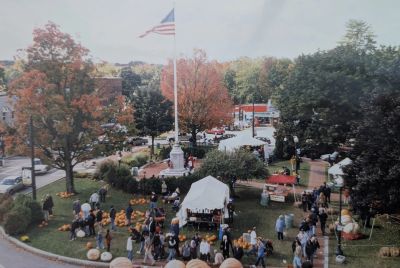
There's a moment at the Milford Pumpkin Festival when the pumpkins, the music, the kettle corn, and the face painting all seem to fade into the background. You step back for just a moment and realize you're witnessing something that really has very little to do with pumpkins at all: a small town coming together in an ordinary—and rather beautiful—way.
Back when it began as the Great Pumpkin Fest in 1990, nobody was thinking on quite that scale. Marilyn Kenison and a small group of volunteers were simply trying to raise a bit of money to restore Milford's Town Hall auditorium. Their original idea was to sell pumpkins around town—almost like an ice cream truck making the neighborhood rounds—before someone suggested bringing everything together on the Oval instead. The first festival was surprisingly small by today's standards. There were, of course, plenty of pumpkins, along with homemade baked goods, a few arts-and-crafts tables, and a handful of volunteers supporting a worthy cause. Among the festival's earliest supporters was Bob Kokko and his family, whose pumpkins quickly became one of its defining traditions—and remain so today.
Then Mother Nature nearly ended the tradition before it ever got off the ground. The inaugural festival arrived during the remnants of a hurricane. At one point, Kenison ducked into the barber shop of Dick the Barber, where she dried her hair before heading back outside. "I thought we would probably never do it again," she later told the Milford Cabinet. Instead, "people came out in the rain, and we raised more money than we'd ever thought." The fundraiser succeeded, the auditorium restoration received an important boost, and what began as a practical community project quietly started becoming something much larger.
The Pumpkin Festival may feel like a thoroughly modern tradition, but in many ways, it echoes one that stretches back more than a century. A hundred years before giant pumpkins filled the Oval, Milford threw a celebration every bit as ambitious as today's festivals.
In October 1911, the town hosted the Milford Industrial Carnival, a celebration so impressive that ten committees spent months planning it. Organizers mailed 10,000 envelopes around the state and handed out 3,000 buttons that simply read, "Best Time Ever, Milford Carnival, October 4–6." The Milford Cabinet called it "a big show staged by all her people to show it deserves something larger than six-point type on the next map of New Hampshire."
And what a show it was. Visitors examined clubs and dark lanterns used in "famous robberies of long ago," admired the "largest basket in the world," big enough to hold nearly two dozen men and boys for a photograph, and watched three fire companies race through town to douse the McLane factory with streams of water—not because anything was actually burning, but simply to show what they could do.
Like the Industrial Carnival before it, today's Pumpkin Festival is remembered as much for its traditions as its attractions.
Even the Pumpkin Festival itself hasn't stood still over the past 35 years.
Organizer Loni Quinn remembers a very different Pumpkin Festival in its early years. Older residents may remember Friday night variety shows with titles like The Legend of Weepy Swallow (or the Tale of the Torsoless Headsman), whose 2001 program warned audiences that "evil is afoot this night" and that a horrifying ghost was looking for revenge. They may also remember the trebuchet operated by Souhegan Valley Dollars for Scholars hurling pumpkins into the Souhegan River toward a floating scarecrow. Before today's Haunted Trail found its home in Emerson Park, volunteers even transformed an old apartment building into a haunted house one year after its owner agreed to let them use it for the weekend.
One thing hasn't changed, however: the giant pumpkins still steal the show. Each year, growers bring their biggest entries to compete in the Giant Pumpkin Weigh-in Contest, sponsored by the Kokko family, whose pumpkins also fill the festival's sales tent on the Oval, the children's pumpkin-painting area on the Community House lawn, and the Milford High School pumpkin decorating contest. The largest entries often tip the scales well north of 1,000 pounds. In 2010, for example, a 1,213-pound entry grown by Barry LeBlanc of Merrimack took the top prize. LeBlanc credited that year's hot summer for producing unusually large pumpkins and, as he told the Nashua Telegraph, admitted there was another reason he kept coming back: "Once you grow one, you get addicted."
Today, children line up for face painting, youngsters build their own scarecrows on the Community House lawn, and Friday night's opening ceremony features the arrival of the Pumpkin Runner, who carries the ceremonial light used to illuminate the giant jack-o'-lantern glowing in the Town Hall window. Food vendors fill Middle Street, musicians perform throughout the weekend, and, of course, those enormous pumpkins remain one of the first things visitors notice.
Spend a little time talking with the organizers, however, and it doesn't take long before the conversation turns to the volunteers. They talk about the Lions Club, Rotary, the Masons, churches, school organizations, the Historical Society, local nonprofits, businesses that stay open throughout the weekend, and the hundreds of people who quietly take responsibility for one small piece of an event that now attracts thousands of visitors each year.
Organizer Wade Campbell put it simply:
"Everything about Milford is there during that weekend."
The giant basket of the early 20th century has given way to the giant pumpkins of the 21st. But the spirit that inspired both celebrations—that some traditions are measured less by their attractions than by the people they bring together—hasn't changed much at all. □